iGlamor Bar Beauty
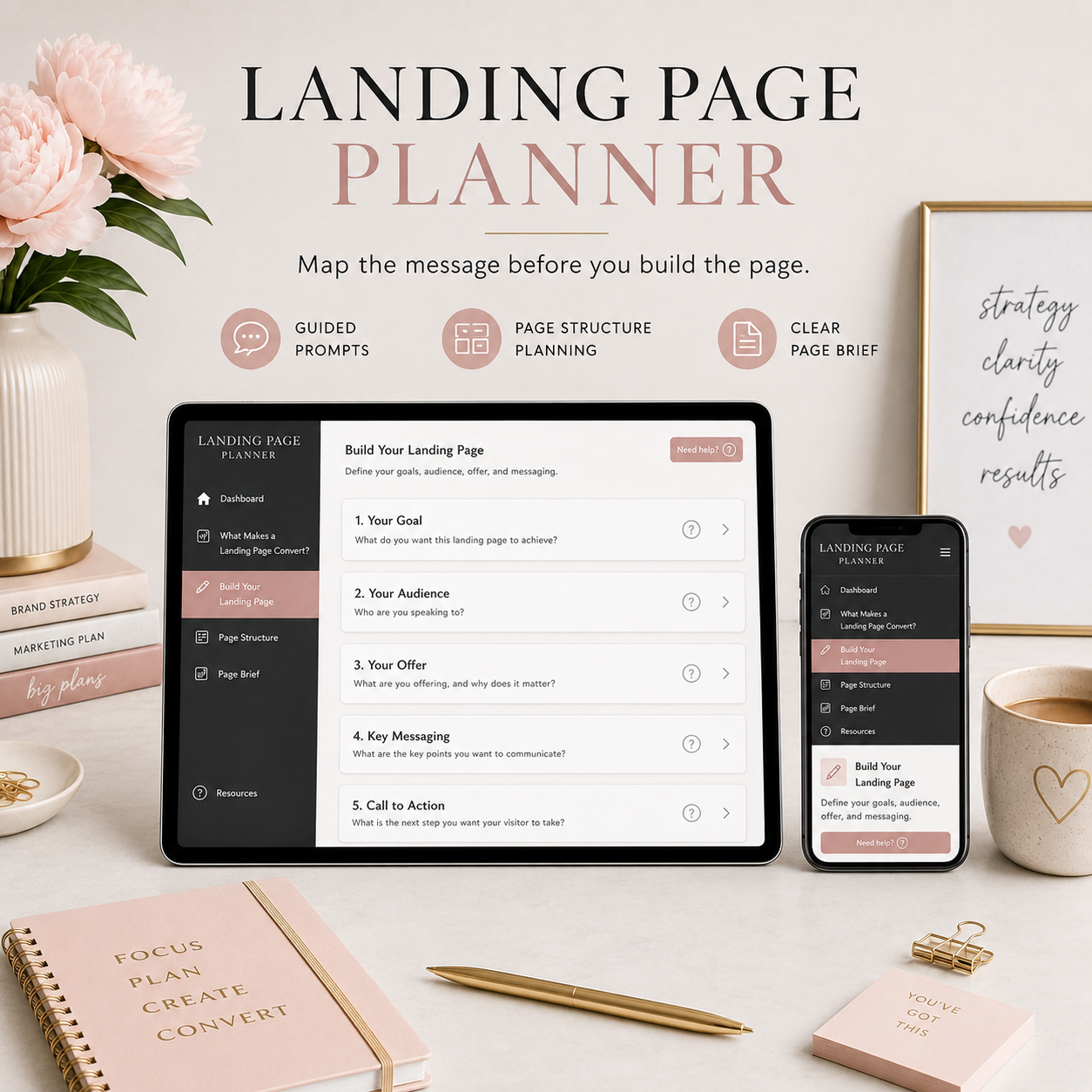
Landing Page Planner
Landing Page Planner
Couldn't load pickup availability
YOU GOT THE CLICK. DON'T LOSE THEM NOW.
A good ad can get someone to your page. But it cannot make a confusing landing page convert.
Landing Page Planner guides you through the message, pain points, desired outcome, offer, value, proof, objections, CTA, and page structure so you know what your page needs to say before you start building it.

You can spend money getting traffic... and lose the sale in seconds.
The visitor clicked because something caught their attention. Then they land on a page that suddenly feels like a completely different conversation.
The most expensive landing-page mistake may not be an ugly design. It may be paying for the click and then giving the visitor no compelling reason to stay.
The visitor needs more than a pretty page.
They need a sequence of reasons to keep going.
A persuasive landing page helps the visitor move from: “This is exactly what I'm dealing with” to: “This makes sense for me” to: “I understand what to do next.”
Stop staring at a blank page wondering what goes where.
Landing Page Planner walks you through the strategy and actual page copy before you touch your website builder.
You will think through:

The little ? helps you think through what to write.
Landing Page Planner does not throw a giant blank form at you and expect you to somehow know conversion strategy.
Understand the Field
Learn what the question actually means and why it matters to the page.
See Weak Examples
Recognize vague, generic, or feature-heavy messaging that may need more work.
See Stronger Examples
Understand how to make the message more specific, relevant, and persuasive.
Ask Better Questions
Use built-in prompts to think through the customer, pain, desire, proof, CTA, and more.
It is not just asking, “What is your headline?”
It helps you think about what the visitor cared enough about to click, what they need to understand next, and what kind of headline continues that conversation.
Don't make the visitor wonder, “Did I click the wrong thing?”
One of the first things the planner helps you think through is what happened before the visitor reached your page.
What did the ad promise? What hook earned the click? What problem or desire did it focus on? What does the visitor expect to see next?
BEFORE THE CLICK
“Stop Running Ad Tests You Learn Nothing From.”
AFTER THE CLICK
“Stop Guessing What to Test Next.”

Make them feel understood before asking them to buy.
“Marketing is hard” is technically a pain point. It is also incredibly easy to ignore.
Landing Page Planner helps you get more specific about:
“Advertising can be difficult.”
MORE SPECIFIC
“You keep spending money testing new ads, but when one performs better you still can't tell whether the hook, image, audience, or offer made the difference.”
Show them what better could look like.
A persuasive page should not spend the entire time reminding people what is wrong. It should also help them picture the outcome they actually want.
What Becomes Easier?
Decisions, planning, organization, execution, understanding, or another real improvement.
What Do They Gain?
Clarity, convenience, confidence, time, organization, simplicity, progress, or another meaningful benefit.
What Do They Stop Dealing With?
Repeated mistakes, unnecessary work, confusion, delays, scattered information, or another genuine frustration.
Pain creates relevance. Desire creates movement.
The page should make the visitor feel both: “Yes, that is exactly what I am dealing with” and: “Yes, that is what I want instead.”
Your offer should feel like the logical bridge.
Current State
The problem the visitor recognizes.
Your Offer
The mechanism, product, or service that helps them move forward.
Desired State
The practical and emotional outcome they care about.
Instead of suddenly saying, “Anyway, here's my product,” the planner helps you build a transition that connects the offer directly to the problem and desired outcome.
Don't just tell them what it has. Show them why it matters.
Feature
What exists?
Function
What does it actually do?
Outcome
What becomes easier or better?
Why It Matters
Why should the customer care?
FEATURE → WHAT IT DOES → FUNCTIONAL OUTCOME → EMOTIONAL OUTCOME → WHY IT MATTERS

Every strong claim creates a question: “Why should I believe you?”
The planner helps you think through what proof you actually have and what claim it supports.
And instead of dumping proof randomly onto the page, you plan where it belongs.
Answer the hesitation before it becomes an exit.
People do not always leave because they hate the offer. Sometimes they leave because one important question never got answered.
“Is this for me?”
“Is it worth it?”
“Do I have time?”
“Why should I trust this?”
“Can't I do this myself?”
“What happens after I buy?”
“I tried something similar.”
“I need to think about it.”
Landing Page Planner helps you decide: what needs clarification, what proof can help, what your response should be, and where on the page the objection belongs.
Make the CTA feel like the logical next step.
The planner helps you think through:
Relevance
↓
Desire
↓
Value
↓
Belief
↓
Reassurance
↓
ACTION
Build a page that earns the next scroll.
Once the messaging is created, Page Structure helps you organize the sections into a logical persuasion path.
Move Sections
Move sections up or down until the page tells the story in the order you want.
Give Every Section a Job
Define whether each section creates relevance, communicates value, builds belief, reduces hesitation, or moves the visitor toward action.
Remove What Doesn't Help
If a section adds no clarity, desire, value, belief, reassurance, or momentum, ask whether it belongs.
Leave with the whole page mapped out.
Page Brief brings everything you created together in the order your landing page should follow.
Take it into the platform you already use.
Use your finished blueprint in:
The 5 questions every landing page needs to answer.
1. Why Should I Care?
Relevance, pain, desire, or an important reason to keep reading.
2. What Is This?
Make the actual offer easy to understand.
3. Why Is It Valuable?
Connect what is included to outcomes the customer cares about.
4. Why Should I Believe You?
Use relevant proof, trust, clarity, and reassurance.
5. What Do I Do Next?
Make the CTA and next step obvious.
If the page cannot answer these...
More design may not be the first thing it needs. More clarity may be.
Not another course you have to finish before you can use it.
Open Landing Page Planner and start planning the real page you need.
Learn the strategy, answer the guided questions, build the sections, organize the structure, and leave with the final blueprint.
What you are not buying:
Don't let the page after it waste the opportunity.
Stop building pages section by section without knowing what each section is supposed to accomplish.
Know the visitor. Continue the message. Press into the real pain. Show the desired outcome. Explain the value. Build belief. Answer the hesitation. Make the action obvious.
Give every section a reason to exist.
Build the message, persuasion path, page structure, proof, objections, and CTA before spending another hour rearranging blocks on a website.
Walk away knowing what the page should say, why it should say it, and where it belongs.
Interactive guided tool • Build your page section by section • Create a complete page brief
Questions before you start?
Is Landing Page Planner a course?
No. It is an interactive browser-based planning and copy-building tool that guides you through the strategy and sections of a landing page.
Does it actually help me build the landing page?
Yes. The Build Your Landing Page section guides you through the foundation, message match, hero, pain and desire, offer and value, How It Works, proof and trust, objections, FAQ, and CTA. Your work is then organized into a final page blueprint.
Does it publish or host the landing page for me?
No. Landing Page Planner helps you create the strategy, copy direction, structure, and final page brief. You then build the actual page using Shopify, WordPress, a funnel builder, or another platform you already use.
Do I need to know copywriting?
No. Important fields include contextual ? guidance with explanations, examples, and questions to help you think through what to write.
Can I plan more than one landing page?
Yes. You can create multiple page plans, save them, reopen them, edit them, duplicate them, and organize different landing pages separately.
Can I use this for services and digital products?
Yes. The framework can be used for sales pages, product pages, services, lead-generation pages, booking pages, waitlists, freebie pages, apps, software, and other landing-page types.
Does the planner write the page automatically with AI?
No. The goal is to help you think through the customer and landing-page strategy instead of generating generic copy. Built-in guidance helps you develop stronger answers as you work.
Can I export or save my final plan?
Yes. The Page Brief brings the page together in one place. You can copy the brief or use your browser's print function to print or save it as a PDF.
Where is my landing-page data stored?
Your data is stored locally in the browser and device where you use the planner. It does not automatically sync between devices.
Does this guarantee my landing page will convert?
No. Conversion performance cannot be guaranteed. Landing Page Planner is designed to help you create a clearer, more structured, more thoughtful landing-page strategy and make more informed decisions about the page you build.
Digital product. Marketing, conversion, revenue, and business results are not guaranteed.